Why My Brain Loves to Predict Disaster
The art club room smells like pencil shavings and old paper, and after school, when everyone has gone home, it is one of my favorite places in the whole building.
That Thursday, I stayed behind with my tote bag on my shoulder and a very small plan. Tomorrow morning, I was going to ask Mr. Hale if I could put one drawing in the autumn art show. One drawing. A question that takes ten seconds to ask.
I had been thinking about it for nine days.
There is an old mirror in the corner of that room, with string lights wrapped around its frame. I stopped in front of it to straighten my sweater. And in the glass, instead of my own tired face, I saw something I did not expect.
A brain. A small pink brain, with a wizard hat covered in stars, and a long purple cloak, and a crystal ball held very carefully in both hands.
The brain looked at me with big, worried eyes. And inside the crystal ball, a storm was turning slowly, full of lightning.
“I have seen tomorrow,” said the brain in a small, grave voice. “Mr. Hale will say no. He will tell you the show is full. The other students will look at your drawing and whisper. You will carry it home in the rain, and you will never draw again.”
What if he says no?
What if everyone whispers?
What if I should never have asked?
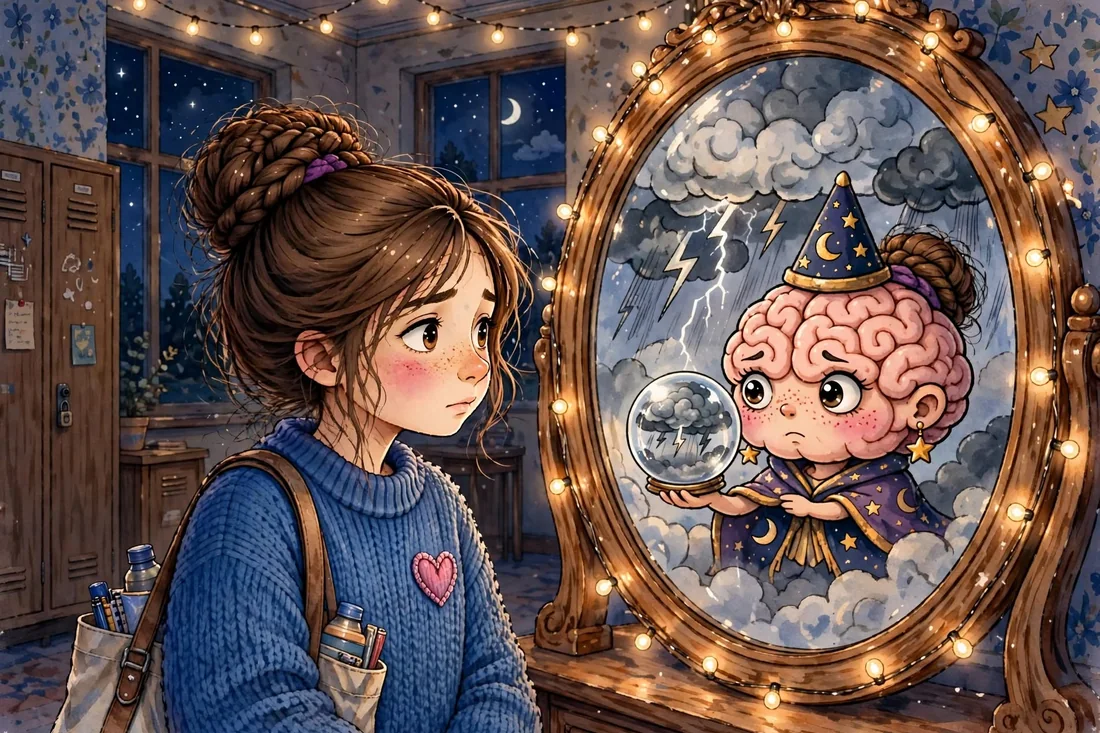
The wizard who works too hard
I did not tell anyone about the wizard. I just walked home with my head down, my tote bag bumping against my side.
But that night, Zoe came over, because she always seems to know. She sat on the rug beside me, cross-legged, in her yellow sweater, with a little brass lantern in her hands that she had borrowed from her grandmother’s shelf.
“Tell me about the prediction,” she said.
So I told her. The wizard. The hat. The crystal ball, and the storm inside it.
Zoe nodded slowly, as if I had told her something perfectly ordinary. “He sounds exhausted.”
“Exhausted?”
“Think about it. His whole job is to keep you safe. And he thinks the best way to do that is to imagine every bad thing first, so you will not be surprised. It is like a lifeguard who shouts about sharks every time you put a toe in the water.”
I laughed. I could not help it. “Even in a puddle.”
“Even in a puddle,” said Zoe. “He is not lying to hurt you, Lina. He is over-helping. Brains are very old, and they learned long ago that it is safer to expect the storm than the sunshine. They never got the update that you are allowed to ask a teacher a question.”
I looked at the lantern. Its little flame made a warm circle on the rug between us.
“So what do I do? Tell him to stop?”
“No. You thank him. And then you ask him one question.” Zoe lifted the lantern, so that the light fell on both of us. “How often have your predictions been right?”
· · ·
Counting the storms
I did not know the answer, so we counted.
Zoe found a clean page in my notebook, and drew a line down the middle. On one side, she wrote The wizard said. On the other side, What really happened. Then we went back, one memory at a time, as far as I could remember.
The wizard said I would forget my lines in the class play. What really happened: I forgot one word, and the whole room did not even notice.
The wizard said nobody would sit with me on the first day of school. What really happened: Zoe sat with me. Then Maya. Then Tessa.
The wizard said my science poster would fall apart. What really happened: it got a gold star, and a small coffee stain.
We found eleven predictions. Eleven storms. And when we looked at the right-hand side of the page, a funny thing happened. Not one of them had come true in the way he had promised. Some of them had come partway. A few small, ordinary things had gone a little wrong, as they do for everyone, and I had survived each one with a tissue and a deep breath.
“Eleven out of eleven,” said Zoe, drawing a tiny crooked circle at the bottom of the page. “Not exactly a perfect fortune teller.”
“He is more like a weather app that always says thunderstorm,” I said.
“Exactly. So next time, you can say: Thank you, wizard. I hear you. And I will wait and see.”
It was strange. The wizard did not disappear. But when I imagined him again, in his crooked hat, he looked a little less certain, and a little more tired, like someone who had been shouting for a very long time and finally heard a friend say, “I’ve got it from here.”
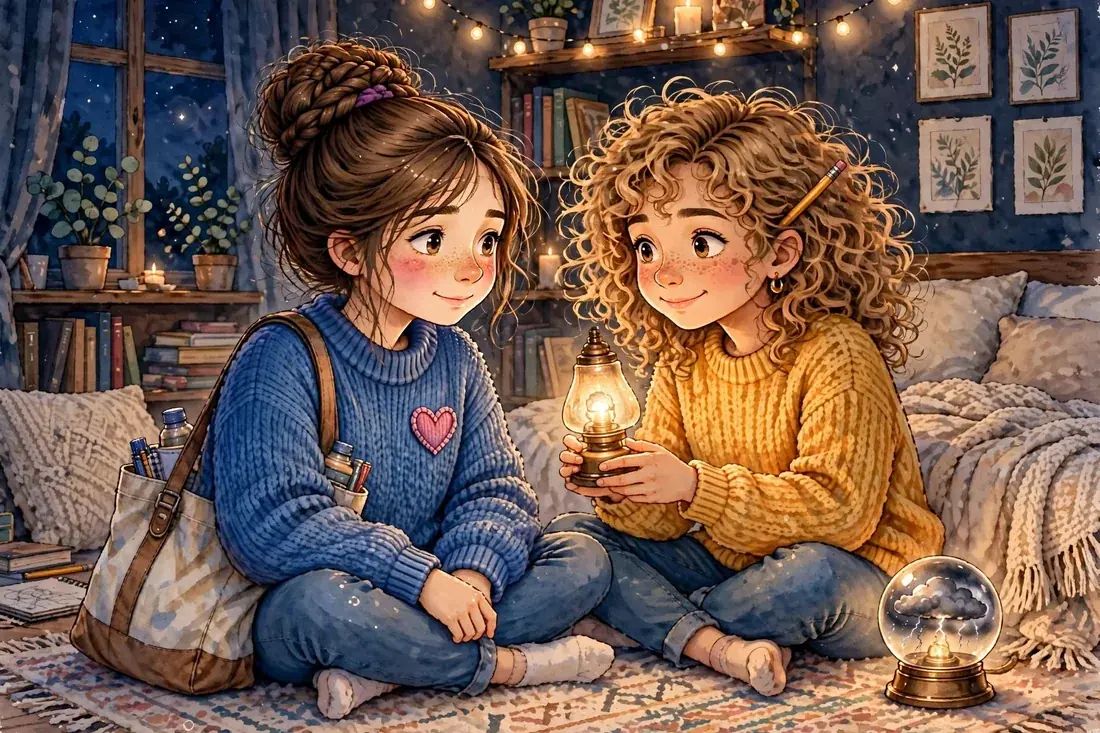
The morning after the storm that never came
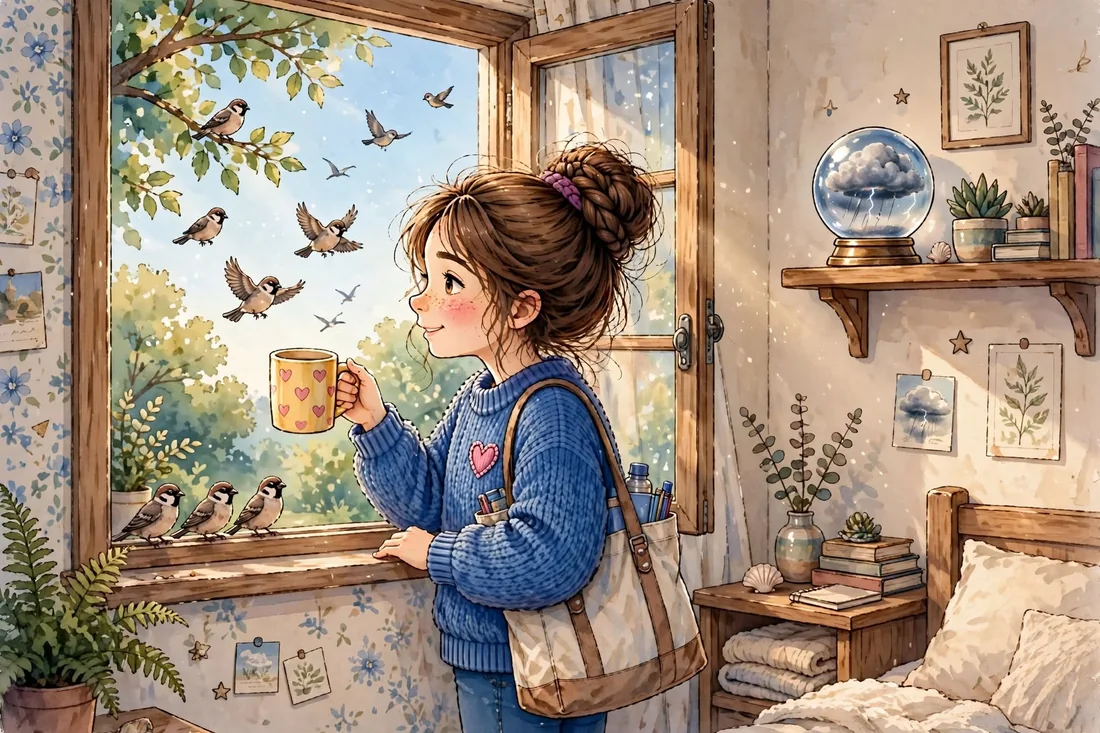
The next morning, the sun came through my window in long, buttery stripes.
I made tea in my heart-covered mug, and I stood at the open window with my tote bag over my shoulder and my drawing rolled up carefully inside it. Three sparrows were sitting on the sill. A few more were flying in lazy circles around the tree, as if they had nowhere important to be.
On my shelf, there was a crystal ball with a tiny storm inside. Zoe had found it at a flea market, and she had given it to me with a bow. “For your wizard,” she had said. “So he has somewhere to look that is not your whole life.”
I could hear him, just a little, as I sipped my tea. What if…
“Thank you,” I said quietly, to the window, to the sparrows, to the small pink wizard on my shelf. “I hear you. I am going to wait and see.”
At school, I found Mr. Hale in the art room, arranging brushes in a jar. My heart was beating loudly, and my voice came out a little smaller than I had planned. But I asked.
He looked up with a smile. “One drawing? Of course, Lina. There is a wall that has been waiting for something exactly like yours. Bring it on Friday and we will find a frame.”
No storm. No whispers. Just a man holding a jar of brushes, saying yes in the most ordinary way in the world.
I do not think my brain will ever stop predicting disaster. It is very good at it. It is a talented wizard, with a long cloak and a lot of lightning. But now I know how to answer. I thank him, I ask for the record, and I light a little lantern. And then I go and see what is really there.
Most days, it is only a window, a cup of tea, and a few sparrows who are not worried about anything at all.
With love,
Lina