The Worst Case Scenario That Never Happened
On Friday night at ten o’clock, I checked the weather forecast for the fourth time.
Forty percent chance of rain. A little gray cloud with three tiny drops sat on my screen, looking very pleased with itself.
The next day was supposed to be my first picnic. Not a big one: just Zoe, me, and a few kind faces I wanted to know better. I had spent the whole week planning it. I had a basket, a checkered blanket, a thermos of apple tea, and fresh bread from the bakery on the corner. I had never invited anyone anywhere before, and my heart was holding the invitation like a hot cup.
And now my brain, which is a very talented filmmaker, had begun to make the movie.
In the first scene, it was pouring. The blanket was soaked, the bread was soup, and my friends stood under a tree in total silence. In the second scene, my bike was lying in a puddle with its chain snapped in half, and I was walking to the park alone, muddy up to my knees. In the third scene, I finally arrived, and the park gate was locked with a big, shiny padlock. Everyone was gone. Everyone had already decided I was too much trouble to wait for.
What if it rains on everything?
What if my bike breaks?
What if the gate is locked and everyone leaves?
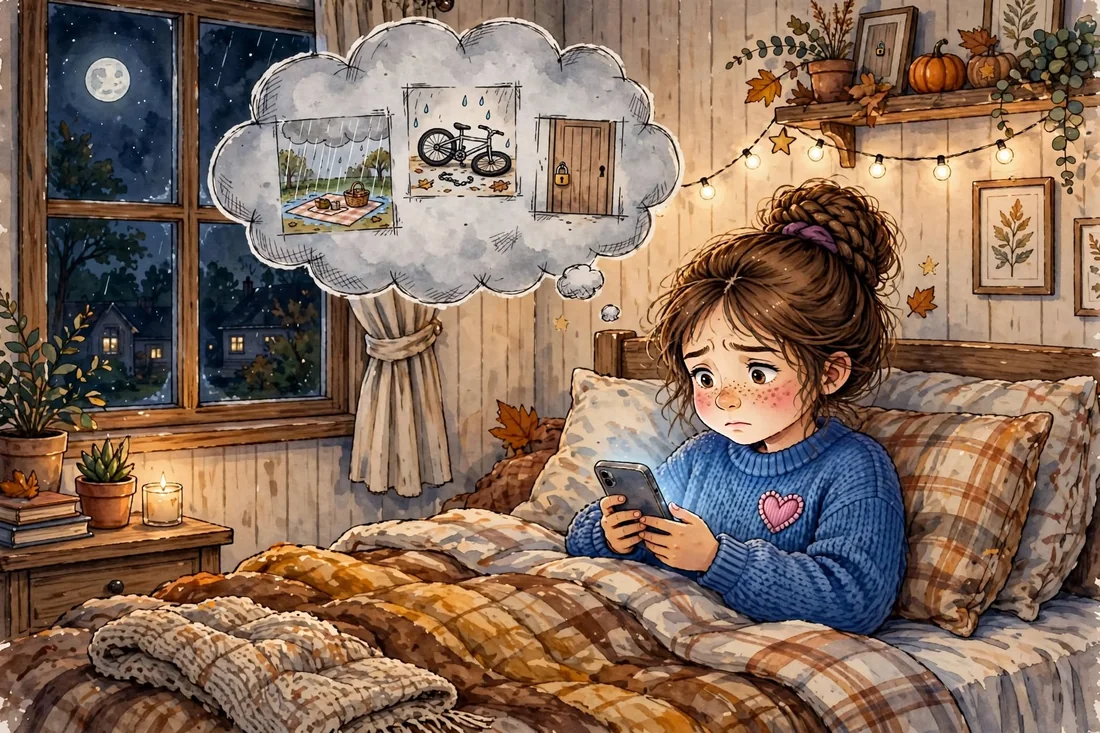
The forecast my brain keeps writing
I texted Zoe at ten forty-two. I think the picnic is going to be a disaster.
Her answer came in less than a minute. Okay. Tell me exactly what happens in the disaster.
So I did. I typed all three scenes, with the rain, the snapped chain, and the padlock. It took a very long message, and my thumbs felt tired afterwards.
Wow, wrote Zoe. That is a lot of things that have not happened.
I looked at the message for a while. She was right, of course. Not one of those scenes was real. They were only guesses, drawn in a very dramatic pencil.
Here’s my idea, she wrote. Tomorrow, we test your forecast. Bring your notebook. We’ll write down every worst case tonight, and tomorrow we’ll write down what actually happened.
I hesitated. What if my forecast is right?
Then we’ll know, said Zoe. And we’ll deal with it together. But I’m betting on the sun.
I opened my notebook and drew a line down the middle of a page. On the left, I wrote What I feared, and under it, in small careful letters: Rain. Broken bike. Locked gate. Then I closed the notebook, tucked it into the basket, and fell asleep with the lamp still on.
· · ·
What actually happened
In the morning, it did rain.
I want to be honest about that. A small, thin, polite drizzle tapped on my window while I ate my toast. For about five minutes, my heart dropped into my slippers, and the first movie began to play again.
But I took a breath, looked out the window, and said out loud, “Let me see what actually happens.”
By the time I had put on my blue sweater, the drizzle had stopped. By the time I had wheeled my bike out of the shed, the sun had come out, shy at first, then golden, then glowing on the wet leaves like a thousand tiny lanterns. My bike chain was perfectly fine. It clicked and hummed all the way to the park, as if it had never even heard of a disaster.
The park gate was wide open. A man in a green jacket was sweeping the leaves off the path, and he waved at me. “Beautiful day for a picnic!” he called.
Zoe was already sitting on the blanket, with her pencil in her curls and two steaming cups in front of her. I opened my mouth and nothing came out except a small gasp.
“So,” said Zoe, trying not to laugh, “what did we learn about the padlock?”
“There was no padlock,” I said.
“And the snapped chain?”
“Perfectly fine.”
“And the flood?”
“It was a drizzle,” I admitted. “For five minutes.”
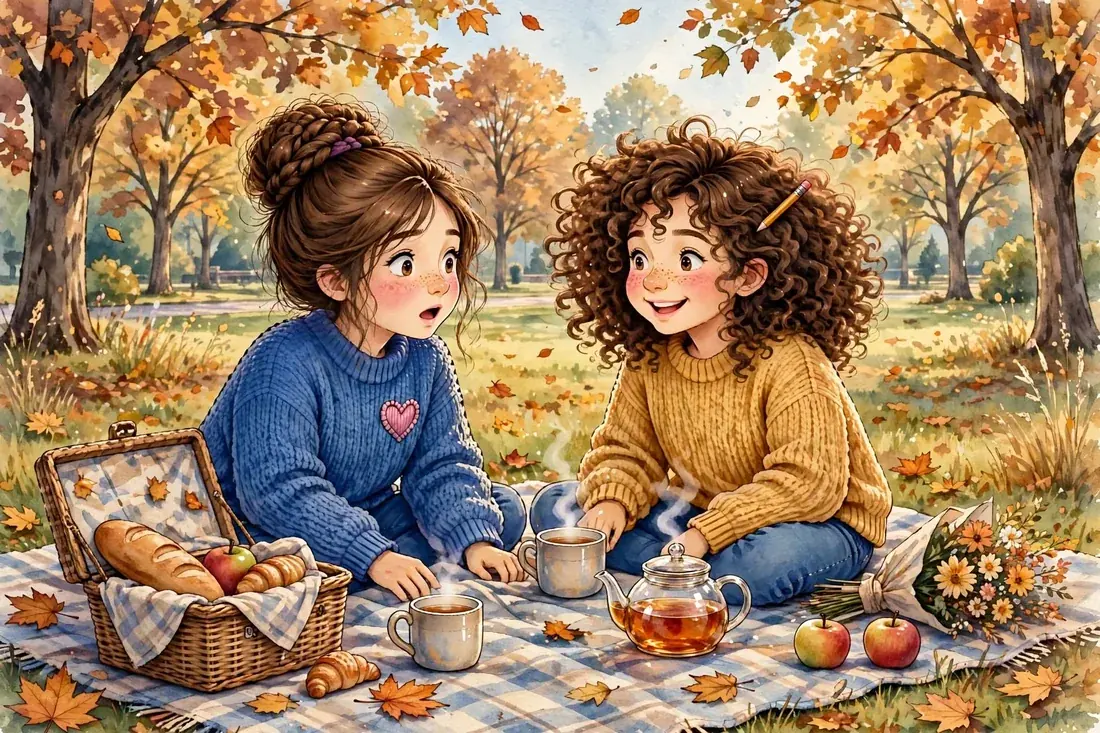
Maya arrived a few minutes later, carrying a bag of warm cinnamon rolls, and Tessa came right after her with a deck of cards. They did not look at their watches. They did not look disappointed. They looked happy to be there, and they sat down on the blanket as if my picnic had always been a good idea.
The afternoon went by in a slow, golden way. We ate the bread. We drank the tea. We laughed so hard at a squirrel who stole an apple that I got hiccups, and Tessa taught us a card game I lost three times in a row. Nobody minded. When the sun began to go down, nobody wanted to go home first.
The right-hand page
That night, I opened my notebook at my desk, under the warm circle of my lamp, and wrote on the right-hand side of the page: What happened.
I wrote: A tiny drizzle for five minutes. The bike was fine. The gate was open. Maya and Tessa came. We laughed.
I looked at the two sides of the page for a long time. On the left, the three terrible movies. On the right, a Saturday with cinnamon rolls.
It wasn’t the first time I had done this. I turned back a few pages and found my old entries, and I smiled at them. I fear: being alone in the dark. Messing up the presentation. They won’t like me. And on the other side, in my own handwriting: Made new friends and we laughed. It went better than expected. They were kind and included me.
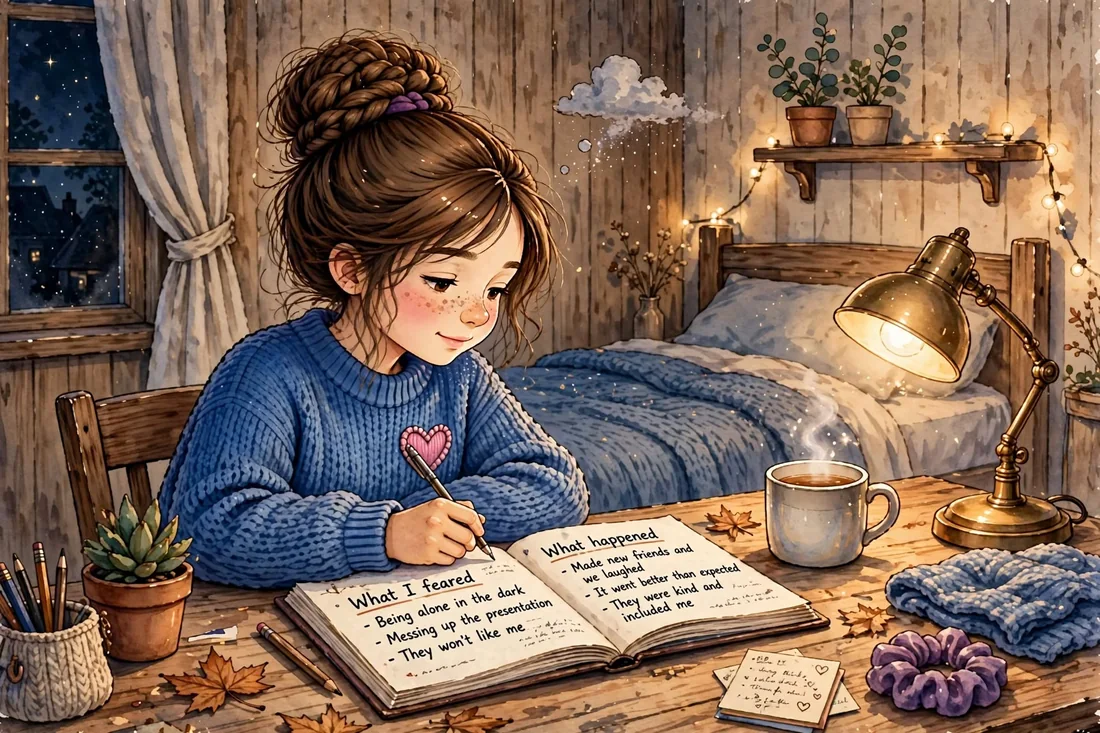
That is the thing I have learned from my notebook. My brain is very good at the left-hand page. It writes it in giant letters, with exclamation marks. But the right-hand page, the one that tells what happened, is always quieter, and always kinder than I expected.
Sometimes the right-hand page says something small and annoying, like I did spill my tea. That is okay. A spilled cup is a spilled cup. It is not the end of the world, and it never becomes the three-scene disaster that my brain promised.
Now, when a new worst case begins to play, I do two things. I write it on a little paper and drop it into a glass jar on my shelf, which Zoe calls the Cloud Jar. And I say, quietly, “Let me see what actually happens.”
Then I open the jar on Sunday, and I read the clouds one by one. Most of them are empty.
And if one of them is not? Then I have Zoe, a warm cup of tea, and a very small list of things I can do next. That has always been enough.
I still do not know what tomorrow will bring. Nobody does, not even the forecast. But I know what my notebook knows: that I can wait and see, and that I can handle much more than the left-hand page ever says.
With love,
Lina