How I Stopped Needing to Be Perfect to Sleep
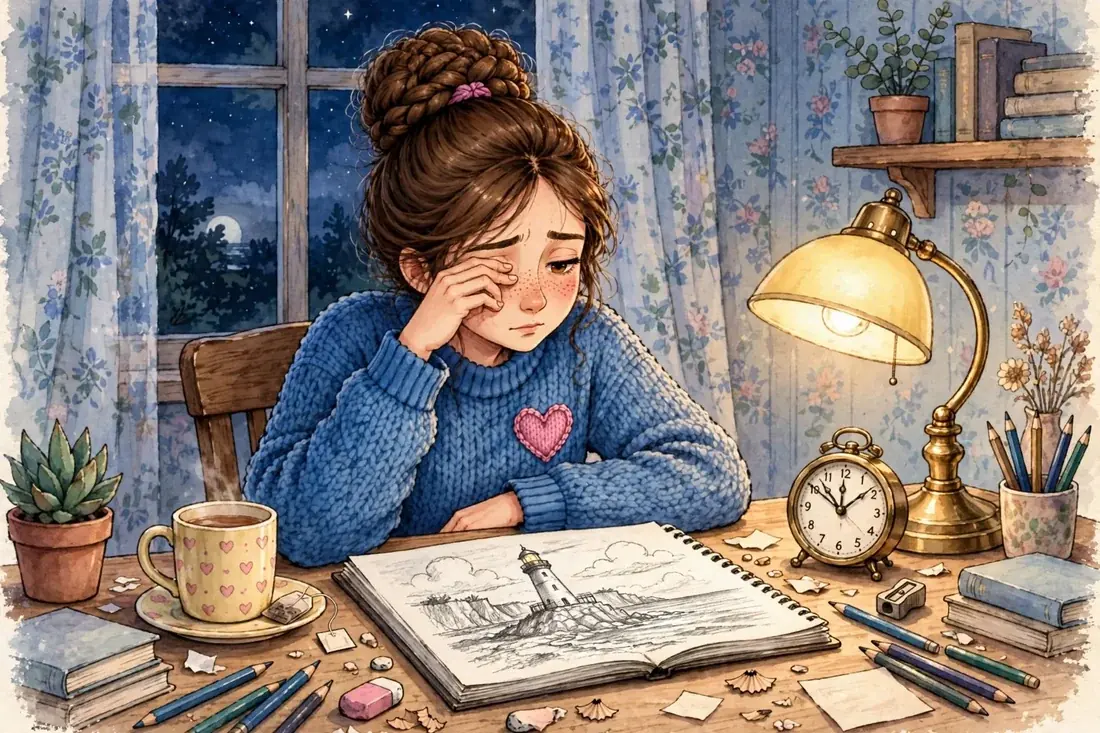
At 11:55 PM, I erased the same line for the ninth time and watched a small gray pile of eraser crumbs grow on my desk.
It was a drawing for the art fair: a lighthouse on a hill, with a tiny window glowing at the top. The lighthouse was fine. The hill was fine. But the line of the roof was almost straight, and almost was not good enough.
That was my rule for the whole week: You may not sleep until this is perfect.
In real life it looked like a girl with red eyes, a worn-out eraser, and a sheet of paper that had started to go thin.
What if I hand it in and everyone sees the crooked roof?
What if it’s not good enough?
A perfect thing that never gets finished
The next day, I told Zoe, and she just pulled a lopsided lump of clay out of her backpack that was shaped, with some goodwill, like a mug.
“I made this on Saturday,” she said proudly. “It leans. The handle is huge. It holds exactly half a cup of tea.”
“It’s done,” said Zoe, and she set it on the bench between us like a trophy. “I use it every morning. You know what I don’t use? Anything still waiting to be perfect. That just sits in a drawer, glowing with potential.”
The leaning mug was, I realized, much more useful than my perfect lighthouse, which did not exist yet.
· · ·
Perfect doesn’t have a bedtime
“Here’s what I think,” she said. “Perfect never says ‘okay, that’s enough for tonight.’ Perfect has no bedtime. You need a different word.”
“Which word?” “Good enough.”
It sounded like giving up. But Zoe explained that good enough is not careless. It is a line that you draw, ahead of time, when your head is clear.
So we wrote three questions on a card, and I read them in the cafeteria until I knew them by heart:
- Is it clear? Could someone understand what I meant?
- Is it kind to the person who will see it? Is it honest and made with care?
- Is it done enough to rest? Would a tired friend call this finished?

If the answer to all three was yes, I was allowed to stop.
The little gold star
That night, at 9:30, with my tea still warm, I held the drawing at arm’s length and asked the three questions out loud. Clear? Yes. Kind? Yes. Done enough to rest?
I waited. The roof was still a little crooked. And I felt the old, familiar pull: just one more line.
“No,” I said, gently, like closing a door. I pressed a tiny gold star sticker into the corner of the paper and turned off the lamp.
It was strange. I did not feel proud or fixed. I felt finished, which turned out to be much better.

At the art fair, Mr. Okafor stopped in front of my lighthouse and said, “I like the little window at the top.” He did not say a word about the roof.
These days, I keep a second card in my drawer: Perfect has no bedtime. I do.
With love,
Lina